

Policymakers across the country want to tax data in all its forms: data processing, digital automated services, data center equipment, digital accounts, and more. In a new blog post for the Tax Foundation, reprinted below, I demonstrate that digital activity isn’t just about high tech firms or AI, but is deeply embedded in every business’s processes, and in everything that we buy as consumers—right down to our breakfast cereal.
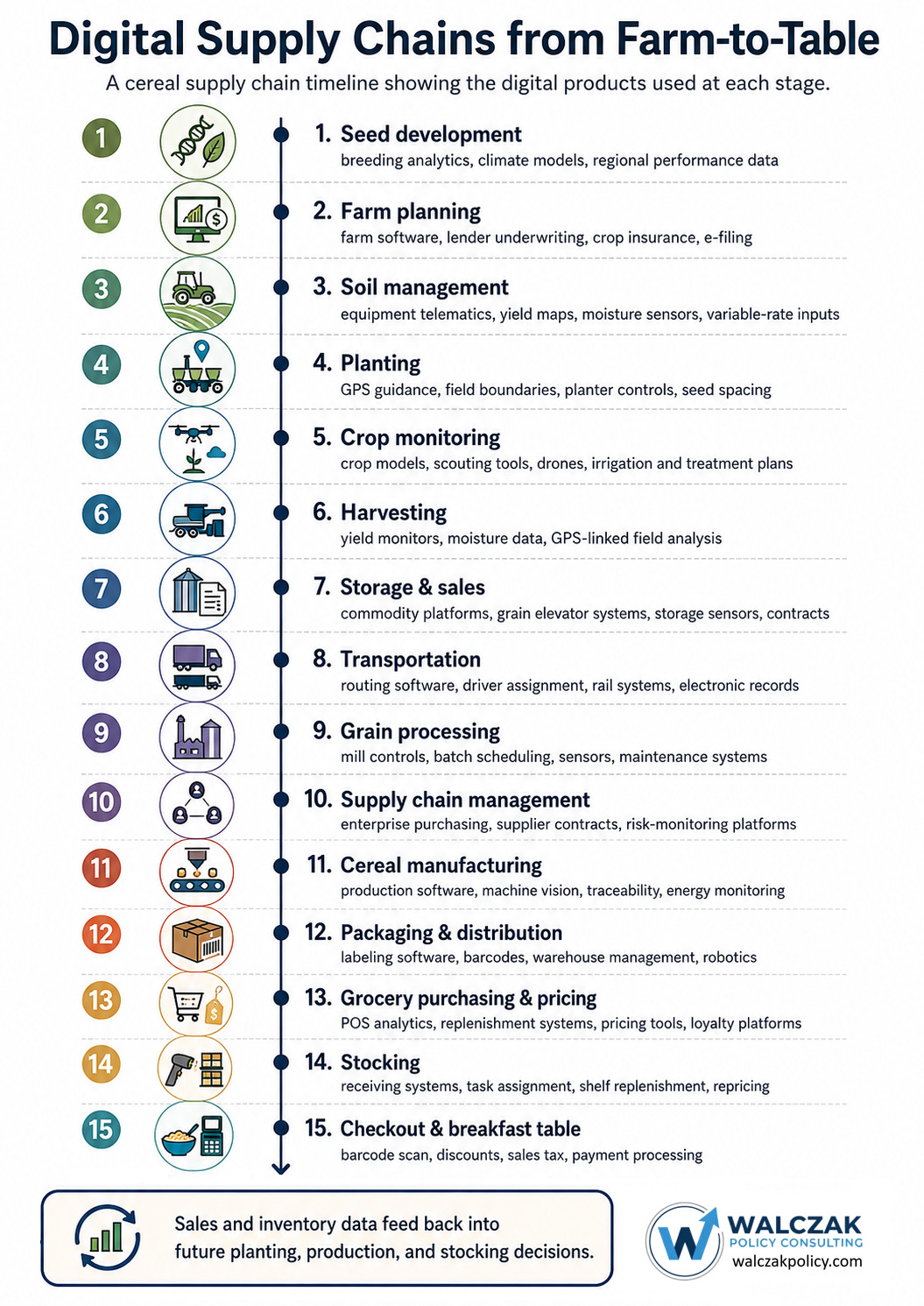
The digital supply chain timeline below offers a brief overview of what this looks like. With full disclosure, I fed my blog post to an AI tool and had it create the graphic based on it, both because (1) that seemed appropriate for the topic and (2) my comparative advantage is in tax policy, not graphic design.
Across the country, policymakers are increasingly interested in taxing data processing and businesses’ digital services. Proposals differ, but they include extending the sales tax to business digital services, imposing excise taxes on data collection, levying new per-user or receipts-based taxes on specific digital activity, or denying data centers the benefit of ordinary sales tax exemptions for production equipment—or some combination of these.
Behind all these proposals is a certain skepticism of “big tech” and data processing, which is often contrasted with “traditional” businesses. But when states tax data processing or levy new or higher taxes on the inputs of data processing, they aren’t just taxing big tech companies but virtually everything, because digital services are so embedded in how we live and how businesses operate.
Consider an example from the supermarket aisle: a box of cereal. We can attempt to track its digital supply chain from the farm (grain production) all the way to the breakfast table.
1. Seed development. Seed companies rely on statistical modeling to compare crop varieties, disease resistance, expected yield, and performance under different soil and weather conditions. Researchers use satellite imagery, climate models, and historical yield data to determine performance in different regions and to provide customized recommendations through dealers’ platforms. All of this requires extensive data processing on cloud-based systems.
2. Farm planning. Today’s farmers use farm management software that analyzes expected commodity prices, seed and fertilizer costs, historical field performance, and other factors to estimate the profitability of different crop plans. Lenders, insurers, and government agencies also rely on digital systems (digital maps, digital underwriting systems, electronic filing systems) in their interactions with the farm operation.
3. Soil management. Modern farm equipment is surprisingly technologically sophisticated. Tractors, combine harvesters, precision planters, and smart sprayers contain yield monitors, moisture sensors, weather readings, and tractor telematics, creating detailed field maps showing soil quality, moisture, temperature, and yield at incredible precision, allowing automated adjustments that tailor the application of fertilizer, pesticides, and water. All these inputs sync to the cloud, where they can be processed and analyzed.
4. Planting. Today’s planters run on GPS guidance, using equipment-control software and digital field boundaries, with automatic adjustments for planting depth and seed spacing based on soil data captured by equipment across the plowing, planting, and harvesting cycles. All of this involves cloud-based data processing and digital automated services.
5. Crop monitoring. Once the grain has been planted, farmers use crop models, field-scouting tools, and sometimes even satellite imagery or (increasingly) drones to monitor conditions, observing changes in plant color or growth and analyzing them for indications of disease, nutrient deficiency, or pest damage. Farmers use digital platforms that monitor rainfall, soil moisture, pests, temperature, and other factors to recommend customized irrigation as well as fertilizer, herbicide, and insecticide application plans. Again, each step involves significant interaction with digital automated services run on data centers, as do the inventory and ordering systems used by suppliers.
6. Harvesting. Modern combine harvesters continuously monitor GPS coordinate-linked crop yield and moisture as they harvest the crop, collecting data that can be used for subsequent plantings, allowing constant refinement of planting and treatment strategies.
7. Storage and sales. Farm operations rely on commodity-pricing platforms to help them decide whether to sell immediately, store the crop for later sale, or enter into a forward contract. If they use commercial grain elevators for storage, those operators also use digital platforms to record deliveries and assess quality, while sensors monitor the grain once stored, with automated systems that can respond to changing conditions. Procurement software, also running in the cloud, can handle contracts, deliveries, and verification processes.
8. Transportation. Once the grain is sold to a cereal factory, trucking companies use transportation management software to assign drivers, schedule pickups, track vehicles, optimize routes, and maintain legal and regulatory compliance. Railroads similarly rely on digital systems, and electronic recordkeeping is used throughout.
9. Grain processing. Grain must be processed—milled, cut, steamed, or rolled—before it can be used in cereal. Processing plants use software to schedule processing runs, manage ingredient batches, coordinate deliveries, and track output. Industrial systems regulate equipment speed, temperature, pressure, precision, and cleaning, with sensors generating vital operational data. Maintenance and procurement systems keep the operation running. All of this involves substantial data processing.
10. Managing the supply chain. In addition to grain purchases, cereal manufacturers need many other inputs and use enterprise purchasing systems to manage contracts, prices, delivery schedules, quality standards, and payment terms. Supply chain risk platforms may be used to monitor and predict potential disruptions.
11. Cereal manufacturing. Once all ingredients are obtained and the grain has been processed, food manufacturers use production software to adjust manufacturing schedules based on shifts in demand, while automated controls regulate every aspect of the production process, like mixing, cooking, puffing, drying, and coating. Sensors are used for continuous quality control, along with cameras and machine-vision systems. Software tracks which ingredients are used in each production batch, along with other information necessary for tracing in the event of a health or safety issue. Digital systems monitor energy use, water consumption, and equipment functionality.
12. Packaging and distribution. Packaging systems control fill weights, label placement, and carton assembly. Digital records throughout the supply chain are maintained and linked to the barcode on each cereal box, along with nutrition information, shelf life, package dimensions, and other machine-readable data attached to the product. Warehouse management software tracks where pallets are stored and directs inventory rotation. Workers interact with these systems using scanners or wearable devices, and robotics may connect to them for transport within facilities. Digital automated systems also determine how many pallets should be sent to each region or distribution center, incorporating a raft of data to predict demand.
13. Grocery chain purchasing and pricing. Grocery chains employ software that analyzes point-of-sale data, inventory, promotions, and local sales patterns to decide which cereals to stock, in what quantity, and on what delivery schedule, for each store. When inventory falls below certain levels, the system may generate a new order automatically. Either at the chain or store level, shelf prices are set by pricing software, and promotion management platforms help guide decisions about discounts, coupons, loyalty offers, and endcap displays. Loyalty accounts and digital coupons available through retailers’ apps use cloud-based data as well. Retailers analyze loyalty program data with software that helps further improve inventory, product placement, and pricing.
14. Stocking. When cereal arrives at the store, software verifies the shipment and updates inventory counts. Store management systems assign tasks such as unloading, stocking, rotating, replenishing, and repricing.
15. Checkout. Finally, at checkout, the store’s point-of-sale system scans the cereal box’s barcode, calculates the price with any discounts, applies sales tax, and updates store inventory. A payment processing network authorizes the payment, and, at long last, the box of cereal is in a consumer’s hands and headed for the breakfast table.
It is easy to conceptualize digital automated services as relevant only to tech companies or to think of data centers as powering only the internet or AI. But every time a sales, excise, or gross receipts tax is applied to business digital services, and every time the equipment used for those services is taxed, those taxes are embedded up and down the supply chain. Consumers pay more for their cereal, even though no tax shows up on the receipt. A product that is nominally untaxed in most states—groceries are usually exempt from the sales tax—can easily embed a heavy tax burden because of taxes conceptualized as falling on “big tech.”
If lawmakers fail to consider this reality when they contemplate new or higher taxes on business digital products or data center inputs, they will wind up taxing groceries at every stage from farm to table, with similar impacts on just about everything else we buy.
Obligatory Marketing Note
My new consultancy provides tax policy research, writing, and other services, both project-specific and on retainer (or in visiting fellow-style roles). If you are in the market for tax policy research or know someone who is, please let me know.
Please Share this Substack
If you find this Substack valuable, please do me a favor and share it with colleagues and others who may be interested. And if you haven’t yet subscribed (it’s free), please consider doing so!