

Populists on both the left and right are increasingly eager to rewrite the distinction long ago identified by Justice Holmes—to concur in regarding all taxes as penalties, and to diverge primarily over whether that can be a good thing.
Holmes’s line about taxes as the price of civilization is often quoted, but many are unaware of the context, from a case that hinged on whether an imposition was a tax or a penalty. “Taxes are what we pay for civilized society … A penalty, on the other hand, is intended altogether to prevent the thing punished.”1
All policy involves tradeoffs, and all things being equal, any tax will tend to produce less of whatever it is levied upon. (“Any tax is a discouragement,” as Justice Holmes wrote in another case.2) For most major taxes, however, this is an unavoidable consequence, not the policy objective. Or at least, that’s largely been true historically.
The left appears increasingly divided on the primary purpose of progressive taxation—whether redistribution is primarily about floors or ceilings.
For one camp, which has dominated real-world progressive policymaking, the basic logic of a progressive, redistributive system is that there is a compelling need for social insurance, housing, education, and health care policies that ensure a sufficient standard of living for all, and that wealthier households have a greater ability to pay for these programs and can thus be expected to contribute more. In this view, wealth is not bad in itself (indeed, it’s necessary for the system to work), it just creates additional obligations to support the welfare of those less well-off.
For another camp, wealth itself is a problem to be solved. New taxes are proposed to address income inequality, with less focus on raising the absolute position of the least fortunate and more focus on closing the relative gap. Taxes are conceived less as the price we all pay for government—even if some are expected to pay much more than others—and more as a penalty on something bad (particularly high incomes or net worth). This doesn’t mean, of course, that those in the latter camp don’t care about the programs that additional revenue funds, but the difference in focus matters.
In one sense, this divide is nothing new. It’s Rawls vs. Dworkin. It’s the difference between instrumental and intrinsic egalitarianism. These debates about equality, egalitarianism, and distributive justice can be found in any textbook. But until recently, a case can be made that most left-leaning lawmakers saw progressive taxes as a means rather than an end: they were, in their view, the fairest way to pay for programs they supported, many of which benefitted lower-income households. They were not intended as punishment of wealth and did not suggest disapprobation.
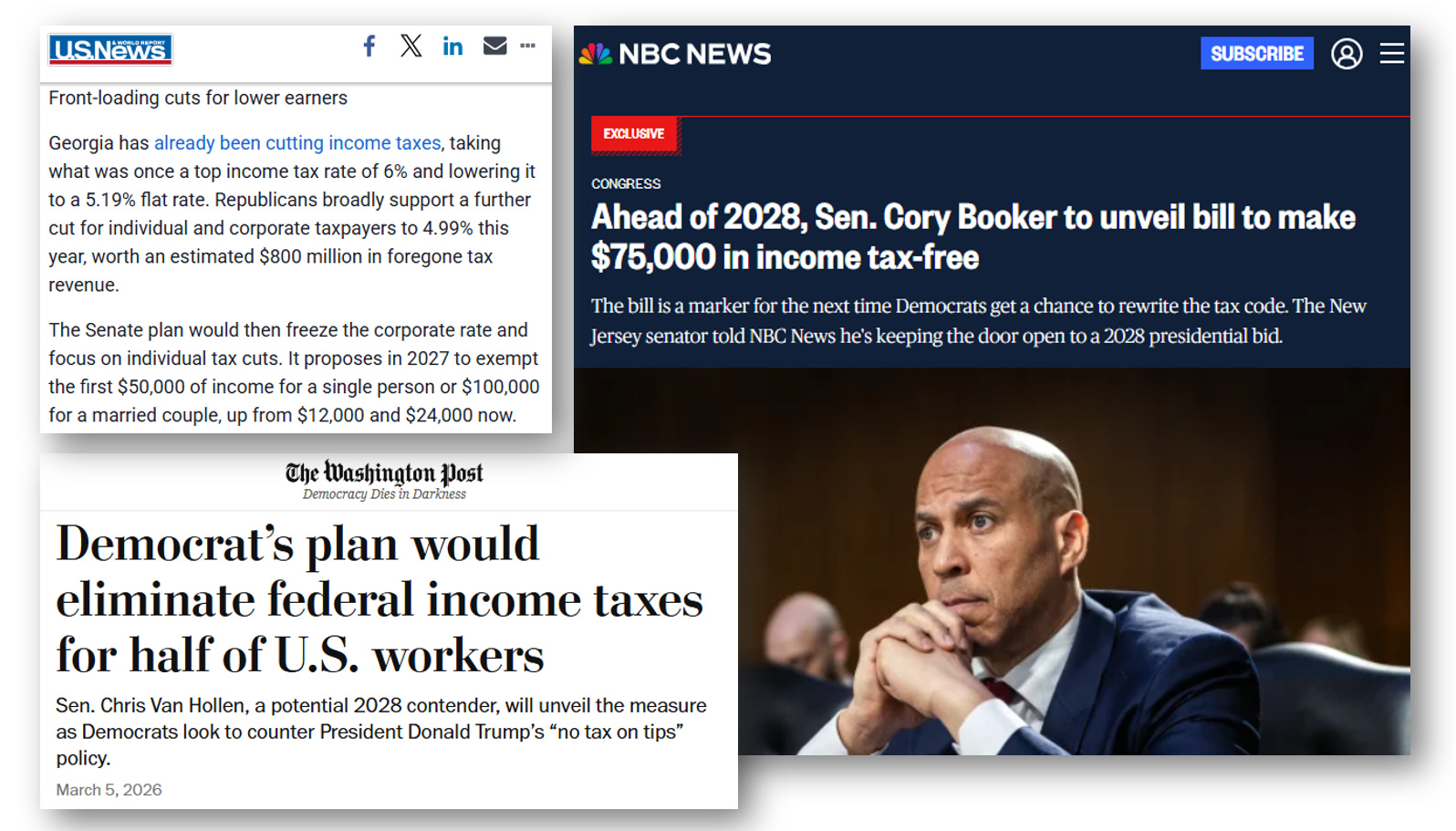
By contrast, consider the proposed California wealth tax, which is to be imposed on “the activity of sustaining excessive accumulations of wealth” (emphasis mine). Or look at Washington, where lawmakers are considering an income tax that only taxes millionaires, or proposals at the federal level that would wipe out income tax liability for many households (eliminated under $92,000 for married couples under Sen. Van Hollen’s proposal, and under $75,000 with Sen. Booker’s), funded by higher rates on high earners.
Politicians on the right are playing the same game, whether it’s “no tax on tips” or state-level proposals to eliminate income taxes for the majority of households. There’s an acknowledgment embedded in each of these proposals, sometimes implicitly and sometimes explicitly, that taxes are viewed as penalties, and that “deserving” people shouldn’t pay taxes.
It’s hard to imagine how this is supposed to work in the long run. There are economic objections: extraordinarily high rates on marginal income and capital accumulation are uniquely harmful. There are stability objections: over-indexing on high-net-worth individuals introduces greater volatility (capital gains realizations are far more volatile than wage income, for instance), which is poorly calibrated to cover recurring, essential expenditures. But there’s also a policy incoherence that those on both the left and right may eventually rue.
For those on the right, pursuing policies that exempt many voters from formerly broad-based taxes will make it harder to keep rates on remaining taxpayers in check. It’s surprising that more conservatives aren’t wary of this, and perhaps less surprising that many progressives are okay with it.
But for the left, convincing voters that middle-class families shouldn’t pay taxes is playing with fire. There’s no realistic level of tax on the wealthiest households that can fund their preferred size of government—or indeed our current size of government—for very long if taxes are reimagined as a penalty on the rich. That’s especially true if the actual stated goal of some (not all) of these proposals is to curb “extreme” or “excess” wealth. The traditional progressive focus on wealthy taxpayers disproportionately funding government is premised on the idea that we will continue to have—and be delighted to have—wealthy taxpayers.
At the risk of oversimplification, the Scandinavian model of progressivity involves broad-based taxes with highly progressive expenditures, while the American model accomplishes more redistribution through taxes themselves, with much more progressive taxes but somewhat less progressive spending.
A Tax Foundation analysis found that the bottom quintile receives $6.17 in transfers per dollar paid in federal, state, and local taxes, while the top quintile receives $0.11. We can also look at this as “effective fiscal incidence,” essentially the net of tax and transfers. If a household paid 10% of their income in taxes but received redistributive transfers worth 30% of their pretax income, they net +20%. The Tax Foundation calculates that the bottom quintile nets +127%, the third quintile nets -2%, and the top quintile nets -31%.
But notably, while this means that about half of households are net beneficiaries under the current tax-and-transfer system, it doesn’t mean that the average household isn’t paying taxes. The Tax Policy Center estimates that the average total federal tax rate for the middle quintile is 7.5%, even though that quintile’s effective individual income tax rate was negative.
In the short run, some progressives might view the adoption of a Van Hollen-style proposal as a victory. Likewise, in the short run, some conservatives might be excited to carve up state income taxes by progressively zeroing out liability for many households. But in the long run, none of this seems sustainable.
Sen. Russell Long, who chaired the Senate Finance Committee for fifteen years, summed up the basic philosophy behind this populist turn for both the left and the right: “Don’t tax you, don’t tax me, tax that fellow behind the tree.” But public finance will be far more precarious if policymakers of all stripes reconceive taxes as penalties and convince the public that taxes are something only other people should pay.
Obligatory Marketing Note
My new consultancy provides tax policy research, writing, and other services, both project-specific and on retainer (or in visiting fellow-style roles). If you are in the market for tax policy research or know someone who is, please let me know.
Please Share this Substack
If you find this Substack valuable, please do me a favor and share it with colleagues and others who may be interested. And if you haven’t yet subscribed (it’s free), please consider doing so!
Compania Gen. de Tabacos de Filipinas v. Collector, 275 U.S. 87, 100 (1927) (Holmes, J., dissenting).
Pacific American Fisheries v. Alaska, 269 U.S. 269 (1925).
Cory Booker isn’t exactly far left though. Progressives don’t like him because he is more of a moderate. So is it really “horseshoe theory” if it is center left and center right/far right? I thought horseshoe theory was more like far left and far right agreeing.
When government services are not perceived as worthwhile, it’s hard to get people to pay for them.
Let’s consider an example. New York spends $40k/kid/year on k-12 education. I can detect no empirical value in this spending. Test scores and parental satisfaction would probably be the same if half or less of this was spent.
So if you go to someone and say “I want to raise your property taxes to pay for this” they are going to be dissatisfied with this request. They aren’t going to say “fuck the kids I’m cheap”. But they aren’t going to vote for the increase either.
“The rich will pay for it” is a way of not having to defend the effectiveness of spending. Who cares if it’s a waste, I didn’t pay for it. Some other guy did.