

A new NFL season is nearly upon us, and to celebrate, I’ve launched a new jock tax calculator that I hope will, more than just being (I hope) entertaining, also serve as a useful jumping-off point for policy conversations about income tax competition and nonresident income tax filing requirements.
The new calculator (jocktax.info) lets you select any player and see an estimate of what they’ll pay in federal, state, and local income taxes, season-long and game-by-game, displaying taxes paid to other states and credits received in domiciliary states. You can also flip a player to any other franchise to see what they’d owe if they played for another team, or you can look at their tax comparison across all 32 teams at a glance. The calculator also permits you to view an entire team’s aggregate tax liability, and to flip rosters to other locations for comparison purposes.
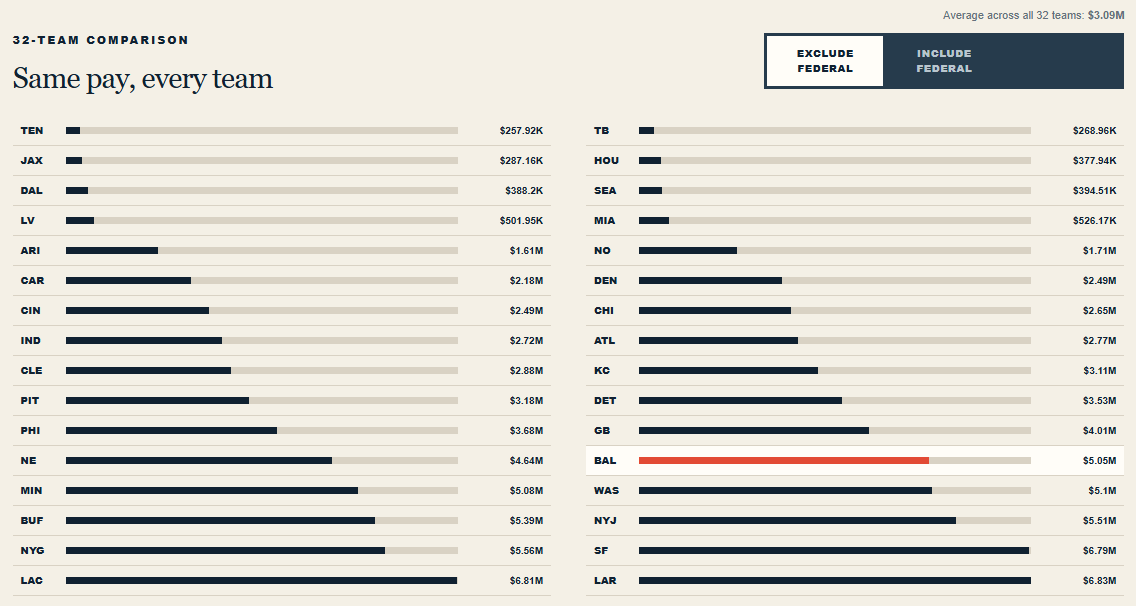
Ravens quarterback Lamar Jackson, for instance, will pay an estimated $5.05 million playing for Baltimore this year. He’d pay $6.83 million with the Los Angeles Rams, and only $256,000 with the Tennessee Titans—all from away games, since Tennessee doesn’t have an individual income tax.
Steelers linebacker T.J. Watt, meanwhile, will pay an estimated $13.79 million in combined federal, state, and local income taxes, including $2.0 million in state and local income taxes, for a total effective rate of 43.08%, while Cowboys receiver CeeDee Lamb will pay $9.62 million, only $232,000 of which is from (away game) state and local income tax liability. Los Angeles Rams quarterback Matthew Stafford takes a $20.06 million tax hit with a 50.14% total effective rate, including $5.3 million in state and local taxes.

The calculator also includes an embeddable widget so that users can run calculations directly on your own website or blog (it works well on WordPress and similar platforms, but not, unfortunately, on Substack), if you want to use it to talk about jock taxes, or about tax competition or nonresident filing rules that affect ordinary people, not just famous athletes. Here’s what the tool looks like embedded in a blog post or website.

Click here to view the calculator. And if you find this calculator useful or interesting, please do me a favor and share it (or this newsletter) with others who might also appreciate it. My hope is that policy organizations can take advantage of this tool as a good NFL season kickoff “hook” for income tax policy conversations.
As I explain in an “About Jock Taxes” section on the site, jock taxes are just a newsworthy example of tax liability imposed on those visiting other states. A short backgrounder follows.
About Jock Taxes and Nonresident Income Taxes
“Jock taxes,” the income taxes that athletes owe to other states and localities when playing away games, are really just a special set of rules for the nonresident income taxes that all of us owe when we earn income out-of-state. Many taxpayers are unaware of this, but 22 states legally require nonresidents to file and remit income tax if they spend even a single day in the state. Other states have filing thresholds, e.g., 30 days before tax is owed.
States use special income allocation rules for athletes and entertainers. Athletes never receive the benefit of filing thresholds, and states use what is called a “duty day” calculation to account for the way athletes and entertainers earn income. If an NFL player is presumed to have 170 duty days (the adjustable default in this calculator) spread across the season, and he spends three days in another state (another adjustable default) to play an away game, then about 1.8% of the player’s income (3/170) is taxable in that nonresident state.
For athletes and ordinary taxpayers alike, your home state is entitled to tax income from all sources (wages, investment income, etc.), wherever it may be earned. Other states are entitled to tax you where you work. Your home state provides a credit for taxes paid to other states, but only up to the amount owed in your home state on that income. If the nonresident state applies a higher effective rate than your home state does, your total tax liability increases. If they apply the same rate or a lower rate, total tax liability remains the same, though that tax is divided across states.
Under jock taxes, all states use an effective rate method, though for the rest of us, states use a mix of effective rate and state taxable income methods. The distinction is important for ordinary taxpayers.
Under an effective rate method, you calculate what your tax liability would be if you earned all your income in the nonresident state, then multiply this by the fraction of income earned in the nonresident state. Under the state taxable income method, you calculate your nonresident tax liability based on the amount of income actually earned in the state.
Consider the difference under California’s highly progressive graduated-rate income tax. A taxpayer with $100,000 in taxable income will face marginal rates ranging from 1% on the first $11,079 to 9.3% on income over $72,724. Neglecting deductions and exemptions, if someone earns $100,000 in total taxable income and $10,000 (10%) of it is in California, then under the state taxable income approach, their $10,000 would all be taxed at 1%, yielding California tax liability of $100. But California uses the effective rate method and instead asks what a taxpayer would pay on all their income, prorating it to California’s share, yielding $574 in California tax liability. All states’ jock taxes use that method.
Jock taxes are a nuisance to professional football players, though home state tax liability still dominates their overall tax bill, which is why some players explicitly take state income taxes into account when weighing contract offers. Because signing bonuses are (usually) only taxable in a player’s state of residence, moreover, many players—especially rookies, who have more flexibility—make an effort to establish domicile in a state without an income tax before signing their contract.
But if jock taxes are a nuisance for professional athletes, nonresident income taxes are even more frustrating for ordinary taxpayers. If someone spends a significant amount of time in a nonresident state, it makes sense to owe income tax there. But the time and expense of filing in a state where you spend a day or two is wildly disproportionate to the amount owed.
A highly-compensated football player with an away game against the Arizona Cardinals has tax professionals to handle his filing obligations. But if an ordinary taxpayer with $100,000 in taxable income works in Arizona for one day, then at least by the letter of the law, they are required to file in the state to remit a grand total of $10.
Most ordinary taxpayers aren’t even aware of their obligation. Compliance is low. Jock taxes on highly paid athletes and entertainers are here to stay, but states could make life easier for the rest of us, at very little cost, by adopting reasonable nonresident filing and withholding thresholds for ordinary taxpayers.
Note: This piece was updated after publication to reflect revised NFL contract data incorporated into the calculator.
Obligatory Marketing Note
Walczak Policy Consulting provides tax policy research, writing, and other services, both project-specific and on retainer (or in visiting fellow-style roles). If you are in the market for tax policy research or know someone who is, please let me know.
Please Share this Substack
If you find this Substack valuable, please do me a favor and share it with colleagues and others who may be interested. And if you haven’t yet subscribed (it’s free), please consider doing so!