

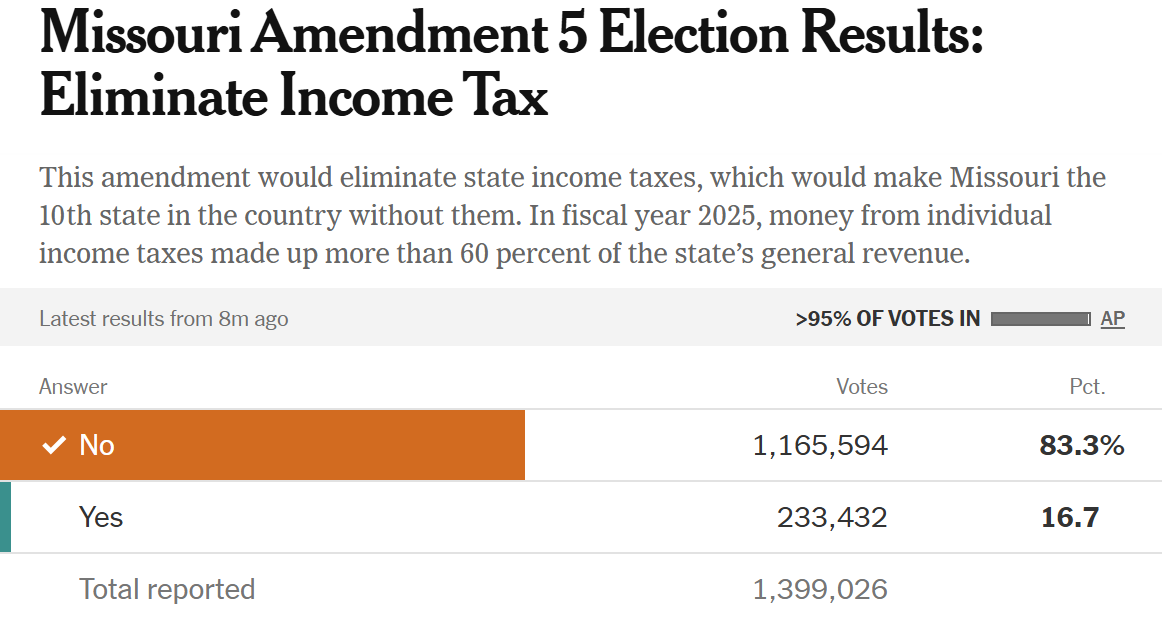
There’s no mincing words here: Missouri’s income tax repeal measure failed in historic fashion, with only 17% of voters backing a constitutional amendment that would have authorized the legislature to broaden the sales tax base and obligated any revenue from that base-broadening to income tax rate reductions, with the goal of ultimate elimination.
The measure lost in every county. Its best performance was 32% in Pemiscot County, and its second-best was 24%. It only received 14% in Boone County, where Kamala Harris won by 10 points, but then, it also received a mere 14% in Caroll County, where Trump won by 64 points. I’d like to share some preliminary thoughts on what happened, and what lessons can be drawn from it.
Don’t settle for half a plan. It’s easy to support income tax repeal, or property tax elimination, or any number of other policies, big or small. Sweating the details is, well, a sweat. While it’s fine and even necessary to identify and work toward goals without having all the answers, at some point it becomes necessary to shift into policymaking mode, which involves identifying and grappling with tradeoffs—including pay-fors, when that’s part of the package.
One possible takeaway from the Missouri vote would be that Missourians love the income tax, and are completely opposed to its abolition. Maybe. I doubt, however, that only 17% of Missouri residents would like to repeal the income tax. That’s too low. What voters communicated is much simpler: “better the devil you know.”
Let’s acknowledge that as a perfectly legitimate, and even prudent, policy instinct. Voters deserve to know what the replacement would be, so they can evaluate it against the current system. Something that is popular in the abstract may prove far less popular when the full tradeoffs are acknowledged, and the failure to acknowledge that there are tradeoffs may meet with legitimate skepticism.
I believe we saw this in Ohio, where it has been difficult for an anti-property tax group to gather enough signatures for a repeal measure that includes no pay-for, leaving that rather consequential detail to be sorted out later. We saw it in North Dakota as well, where a similar measure failed. And I think we saw it in Missouri, where some meaningful percentage of voters who would have been theoretically open to eliminating the income tax had some very reasonable qualms about supporting a measure without knowing what the alternative revenue streams would be.
Of course, voters may also have been acting on incomplete or inaccurate information. The measure did not require lawmakers to repeal the income tax, and voters who heard that it involved sales tax expansion to particular categories were only being given speculative and potentially adversarial replacement options that may never have had a chance in the legislature. In reality, lawmakers likely would have avoided many of those, which would have meant income tax reduction, not elimination.
Still, it’s fair to judge a measure by what its proponents say it will do. The measure was sold as providing for income tax elimination, and the only way to accomplish that would have involved sales tax base broadening into unrealistic and undesirable areas.
Don’t confuse means and ends. Another lesson is to not confuse means and ends. Historically, many policymakers have favored income tax rate reductions and even income tax abolition as a means toward the end of greater economic competitiveness. The literature supports the idea that lower income taxes are more pro-growth and that shifting tax burdens more towards consumption can be an economically competitive move. However, when lawmakers lose sight of income tax reductions or even elimination as a means and instead treat it as an end in itself, they may be willing to adopt any pay-for whatsoever, or to accept highly unrealistic revenue forecasts, as long as it moves them towards their newly desired end.
Turning the sales tax into a gross receipts tax, which might have been necessary to eliminate Missouri’s income tax with base broadening, does not make the state more competitive, even with the income tax gone. In fact, the very arguments for income tax reductions—shifting the burden away from labor and investment and toward consumption—are ignored if the replacement involves putting sales tax directly on capital investment and production. This is a terrible deal if the goal is greater economic competitiveness, but it’s easy to lose sight of that if the goal has become income tax elimination at all costs.
Don’t live in a bubble. I was only mildly surprised by the outcome of Missouri Amendment 5. I expected the “No” vote to be in the 70-75% range, and it unofficially stands higher than that, at 83%. What’s been more surprising: how surprised other people are. I’ve had half a dozen people express shock that it lost by this much. (They didn’t expect it to win but thought it would be closer.) It’s easy, in the policy community, to lose sight of how ordinary people are thinking about policy issues, or to believe that online discourse is representative. It’s equally easy to assume that people—even smart, well-informed people—know things that policy professionals assume are common knowledge, but which absolutely are not.
Many voters likely misunderstood what Amendment 5 did. That doesn’t mean it would have passed if they understood it better (I’m confident it would not have), but it’s still important to recognize. And just because someone shares a point on the ideological spectrum with policymakers who favor a given policy aim doesn’t mean they’ve heard even the basic arguments for that policy.
Unfortunately, as someone who is concerned about many emerging proposals on property tax relief or elimination, we also need to acknowledge that voters who may once have been interested in income tax reductions or broader pro-growth tax reform may now see that as a distraction from property tax repeal. That isn’t an argument for abandoning better policy options. Rather, it’s an argument for not assuming that people know the arguments for them, and for doing the hard work of policy education.
Don’t be afraid to speak out. It’s easy to criticize policies you disagree with outright. It’s far harder to critique proposals that you believe are directionally correct, and in line with your broader policy aims, but which are flawed in their design or execution. That doesn’t make doing so any less important.
Missouri Amendment 5 is an edge case, because the actual measure is defensible: all it did was empower lawmakers to broaden the sales tax base to pay down income tax rate reductions, which can be good policy. However, it was clearly sold as a plan to eliminate the individual income tax, and any imaginable way that it could have done that would have been poor policy. That’s how I framed the measure when I spoke with journalists: there are advantages to restoring legislative capacity to modify the sales tax base (which was stripped away by a previous ballot measure), and it’s smart to use sales tax right-sizing to support income tax relief. But if lawmakers see this as a mandate to eliminate the income tax using base-broadening, the cure would be far worse than the disease.
Other efforts provide more clear-cut examples. Years ago, for instance, I wrote a paper taking sharp exception with then-West Virginia Gov. Jim Justice’s income tax abolition plan, which created a murderer’s row of ugly replacement taxes to pay for it. I also delivered legislative testimony in Mississippi explaining why the pay-fors in their income tax phase-out plan were woefully inadequate and would harm the state. And earlier this year, I wrote about why North Carolina should fix their most recent round of revenue triggers, which have the potential to trigger when they shouldn’t.
Not everyone has appreciated these critiques, but they were the right thing to do. First, it was right on policy, and promoting sound policy should always be the goal. Second, it was right as a matter of intellectual honesty: I wanted West Virginia to cut income tax rates, for instance, but I knew the governor’s plan was a bad one, so it would have been wrong for me not to acknowledge that. Third, it’s valuable reputationally: if we want to have credibility when we argue for well-designed tax reform, it’s not enough to stay silent about poorly designed reforms. And fourth, it’s crucial to future policy victories: one rotten apple really does spoil the bunch.
Remember, there are countless stories of states that have succeeded with responsible income tax relief, but none of them has anywhere near the salience of the failed Kansas experiment—which was predictably a disaster from the start.
Again, Amendment 5 is an edge case. And there will always be legitimate disagreements about how to approach tax reform, and when to accept an imperfect plan (because they’re all imperfect). But we’ll all be better off if those in the policy community voice their concerns or objections, with the goal of better policy outcomes, rather than biting their tongues.
Obligatory Marketing Note
My new consultancy provides tax policy research, writing, and other services, both project-specific and on retainer (or in visiting fellow-style roles). If you are in the market for tax policy research or know someone who is, please let me know.
Please Share this Substack
If you find this Substack valuable, please do me a favor and share it with colleagues and others who may be interested. And if you haven’t yet subscribed (it’s free), please consider doing so!