

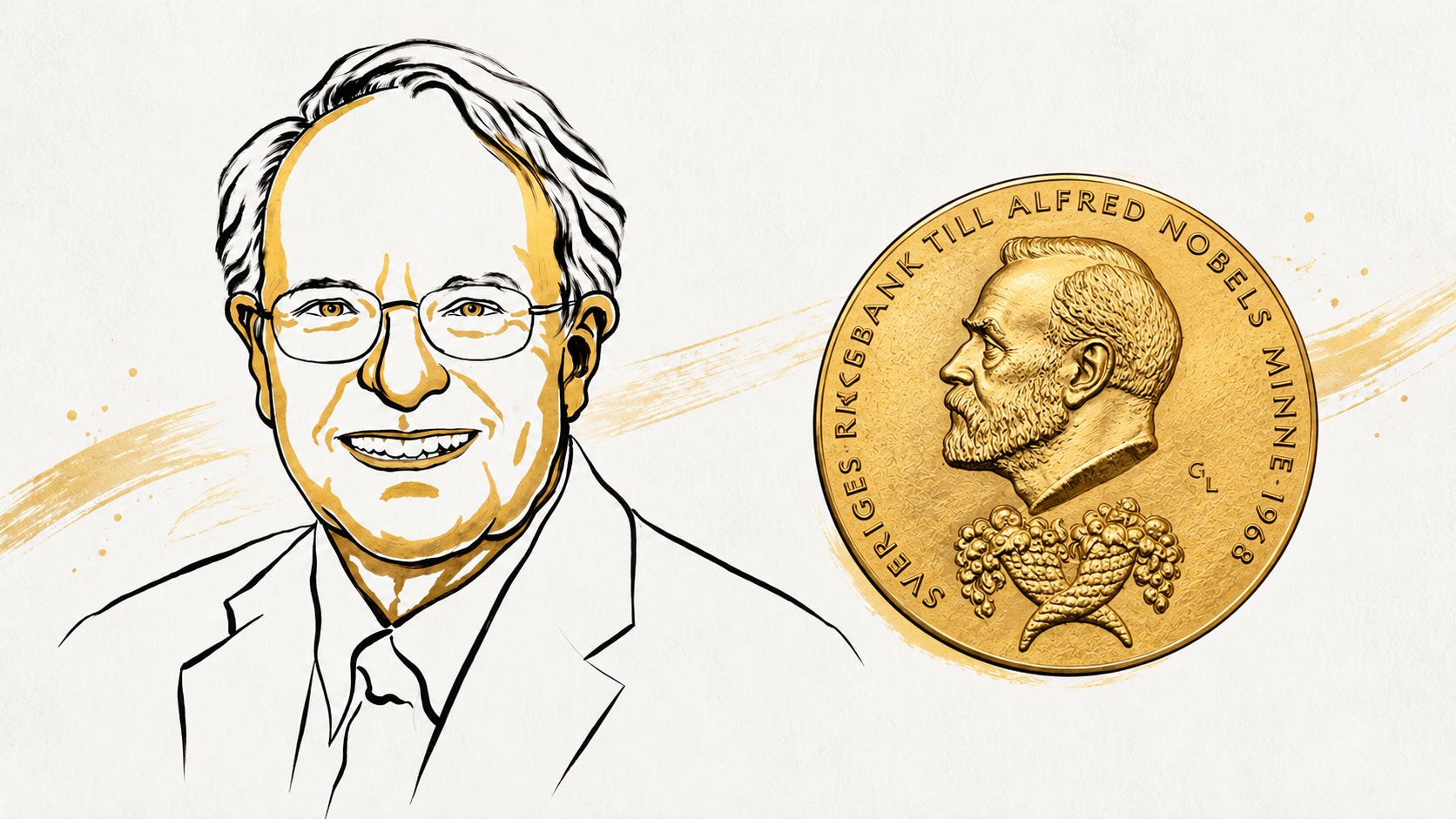
Robert Hall, who shared this year’s Nobel Prize in Economic Sciences with Michael Woodford, won for work on “microfoundations of macroeconomic stabilisation.” But Hall, whose impressive career spans many decades and topics, is notable for work on a broad range of economic issues. Today I want to provide a high-level synopsis of a few of his key ideas and how they relate to tax policy.
1. Consumption is relatively stable and doesn’t respond much to temporary policy.
In 1978, Hall published a paper suggesting that changes in spending should be almost impossible to predict, since current spending levels should already reflect what consumers expect about their lifetime earnings. This is a stylized assumption that shouldn’t be taken literally, but the idea—broadly supported by subsequent research—is that expected pay raises, anticipated bonuses, and predictable business cycles shouldn’t move spending much, because they were already baked in. Only true surprises should meaningfully alter spending, and by definition, we can’t predict true surprises. The best forecast of next year’s spending, therefore, is this year’s spending.
One implication of this is that temporary tax changes do less to change behavior than permanent ones. A one-time rebate or a sales tax holiday might shift the timing of consumption, but is unlikely to change overall consumption levels. Another implication is that consumption is smoother than income, and thus a consumption tax is more stable than an income tax, especially one that taxes capital gains.
2. For investment, what matters is the “user cost of capital.”
Along with Dale Jorgenson, Hall wrote a 1967 paper outlining how firms considering making a capital investment weigh what the investment will earn against its “user cost,” the effective annual cost of owning the equipment. That cost includes the interest rate, the equipment’s useful life, and the tax costs, not just the purchase price. If firms must deduct the cost of machinery and equipment purchases across many years according to statutory depreciation schedules (which approximate economic depreciation under a Haig–Simons definition of income), those deductions are worth less than par due to inflation and the time value of money. This creates a hidden tax on investment. While Hall and Jorgenson didn’t create the concept of full expensing—if anyone deserves that honor, it is E. Cary Brown two decades prior—their framework made the user cost of capital an empirical tool, one that Hall and others would later build upon.
3. A properly designed flat tax is really a consumption tax.
Writing with Alvin Rabushka in the 1980s, Hall developed a flat tax proposal (updated in 2007) that has come to define what economists mean by flat—not just single-rate, but imposed only on what people spend, not what they save. Under their tax, businesses are taxed on their cash flow: revenue minus wages, purchases, and investment costs (under full first-year expensing). Workers pay a single-rate tax on wages above a generous exemption. Interest, dividends, and capital gains are not taxed at the personal level, since they are already taxed at the business level. The result is progressive, inasmuch as it can exempt low-wage earners, but above that it is flat not just in rate but in its base, with no double taxation.
While Hall-Rabushka features a single rate, their tax base also points the way toward progressive consumed income taxes. The destination-based cash flow tax (DBCFT) championed by Paul Ryan and Kevin Brady was a progressive tax proposal built on the cash-flow base from Hall-Rabushka (mediated through the work of Alan Auerbach and others), and other tax reform proposals are likewise indebted to Hall and Rabushka. Adopting full expensing of machinery and equipment purchases temporarily in the TCJA, and then making it permanent, restoring the research and experimentation first-year deduction, and adding a (for now, temporary) full expensing regime for certain structures under H.R. 1, all move the tax code at least moderately in this direction, and states are deciding whether to follow. Meanwhile, some other countries (Estonia most notably) have built tax codes that draw on Hall-Rabushka, even if none fully implement it.
4. Wages are sticky.
Standard employment models predicted much smaller swings in unemployment than was observed in reality. Hall showed that the models failed because they made wages too flexible, when in fact wages are somewhat “sticky.” He developed a model of how employers and employees bargain over wages that suggests that when conditions change, wage adjustments take time (with, as others have subsequently demonstrated, downward nominal wage rigidity), mainly showing up through slower growth (or no growth) in real wages, rather than an actual reduction. This means that the initial response to a rise in the tax cost of labor is lower employment, even if the long-run effect is lower wages. It also means that when demand falls (like in a recession, though also when demand falls within a particular industry), wages don’t drop enough to maintain employment levels, resulting in more unemployment than would otherwise be expected.
5. Entrepreneurship requires unusually high risk tolerance.
As with much of Hall’s work, his 2010 paper on entrepreneurship, co-authored with his wife Susan Woodward, isn’t entirely novel, but it does provide an improved empirical framework for analysis. Hall and Woodward studied venture-backed startups and found, unsurprisingly, that while payoffs for successful founders were large, most founders got nothing for their effort, and founders are unable to diversify: when the business flops, their career and savings go with it. Entrepreneurship therefore requires unusually high risk tolerance. Roughly three-quarters of VC-backed entrepreneurs make no return on their venture. This isn’t a tax paper, but it suggests that taxes that take a large share of a successful business’s proceeds, and that apply even when a business is unprofitable, make entrepreneurial risk even less attractive. That has implications for wealth taxes, but also for tax provisions that cap net operating loss deductions or for high progressive rates that place an entrepreneur in the top bracket the year in which they sell their business.
6. Social infrastructure matters for productivity.
Hall, along with Charles Jones, took an empirical approach to ideas advanced by Douglass North (himself a Nobel laureate), Mancur Olson, and others, demonstrating that productivity is inadequately explained by capital investment, education levels, and the like. Productivity, Hall and Jones show, tracks “social infrastructure,” the set of institutions and policies that determine whether wealth is best pursued by production or by rent-seeking. Theirs is a national model and largely explores the diversion of effort in the context of significant rent-seeking, corruption, and expropriation at a scale not found in the United States (which helps explain why the U.S. shows high levels of productivity). However, at a much smaller scale, the same insights hold for tax codes filled with targeted credits, negotiated abatements, and other non-neutral provisions that reward lobbying and adjusting business models to fit the tax code, rather than rewarding innovation and sound economic decision-making.
Daron Acemoglu and James Robinson built on Hall and Jones and developed their own theory based on inclusive versus extractive institutions (and won a Nobel for it), and economists and economic historians like Joel Mokyr and Philippe Aghion (who shared a Nobel last year), and Deirdre McCloskey, have developed a contrasting body of work focusing on cultural transformations as a precursor to institutional change, and perhaps the more important development.
I can only scratch the surface of his many contributions and have largely limited myself to those with clear tax policy implications (ignoring, for instance, his important work on health spending). Hall’s Nobel is richly deserved for a lengthy career’s worth of valuable insights paired with useful empirical frameworks.
Obligatory Marketing Note
My consultancy provides tax policy research, writing, and other services, both project-specific and on retainer (or in visiting fellow-style roles). If you are in the market for tax policy research or know someone who is, please let me know.
Please Share this Substack
If you find this Substack valuable, please do me a favor and share it with colleagues and others who may be interested. And if you haven’t yet subscribed (it’s free), please consider doing so!