

“Those who would give up essential Liberty, to purchase a little temporary Safety, deserve neither Liberty nor Safety.” It is among the better-remembered quotes from an eminently quotable founder. Few, however, would guess at the context: the “essential Liberty” was the right to levy a property tax.
Franklin’s words are not of Revolutionary War vintage, but rather much earlier, from 1755, as part of the Pennsylvania Assembly’s Reply to Deputy Governor Robert Hunter Morris on a matter of financing.
It had been a bad year for the Province of Pennsylvania. A year prior, in Fayette County, a young colonel by the name of Washington, dispatched by Governor Dinwiddie of Virginia, had committed a blunder that arguably transformed isolated skirmishes into what would become a very real war. And not just any war, but a war that would be fought on five continents.
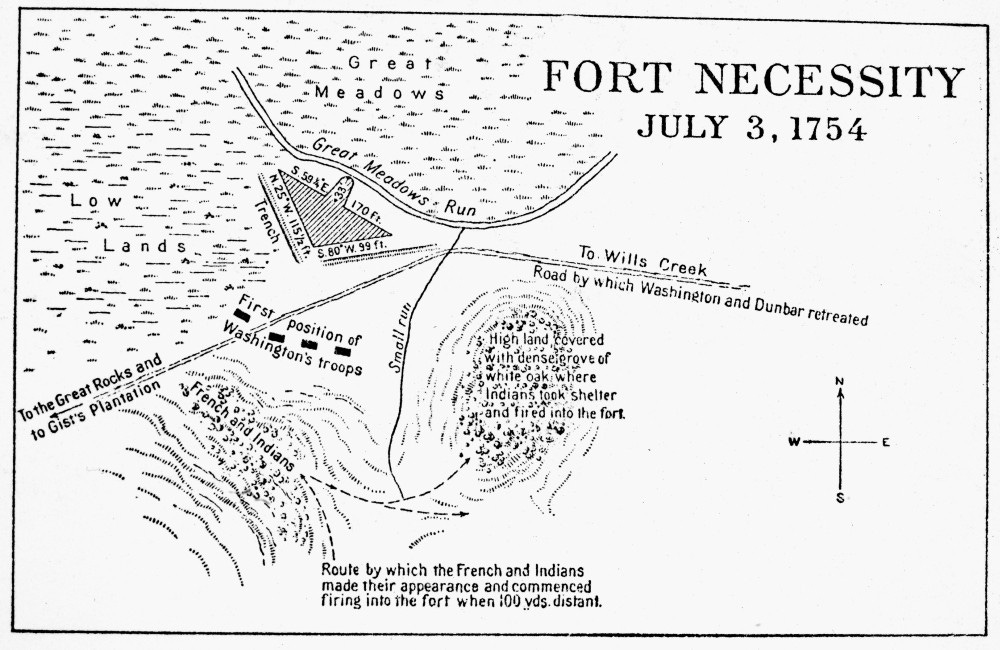
The Dinwiddie Expedition was responding to a series of raids by several Native American tribes in the turbulent frontier of the Ohio Valley — tribes once loyal to the British, but clearly acting according to French incitement. Washington established a stockade he called Fort Necessity, but soon advanced beyond it in an ill-conceived assault from which he quickly retreated.
Responding to Washington’s parry, the French converged on Fort Necessity, and in the melee that followed, the brother of the French commander, approaching the fort under a white flag, was captured by Washington’s troops. What ensued is shrouded in mystery. Most primary sources claim, and the French believed, that Washington ordered the French officer’s illegal capture and acceded to his subsequent murder in captivity to appease a Native American ally (the “Half King”) with a grudge. Washington himself contended that he distrusted the man’s intentions, hence his capture, but that he did not sanction the murder. Whatever the case, the effect of the Jumonville Incident was almost immediate: France and Great Britain were at war, and Western Pennsylvania was the first theater of battle.
The British sent General Braddock to lead an expedition against the French, an expedition that ended badly, with Braddock dead, his aide (again, a young Washington) fleeing, and the French taking the foundation of a British fort and turning it into their own Fort Duquesne. By now, the Delaware and Shawnee Indians were firmly in the French camp, conducting frequent raids on British settlements in the Alleghenies. The Crown was alarmed. So was Pennsylvania’s Deputy Governor, Morris.
Pennsylvania was a proprietary colony, essentially feudal in nature, and two heirs of William Penn, Thomas and Richard, were its proprietors at the time. The head of government was the Deputy Governor, who legally served the interests of the proprietors, not the people.
As a proprietary colony, the Province of Pennsylvania operated under unique rules. The vast majority of land outside Philadelphia was itself proprietary, held in fief by a few major landowners. Since most of the land was forested and unproductive, the charter afforded an exemption from any taxation of this proprietary property, one the Assembly could not override.
This was not the only way the Assembly’s hands were tied: the Deputy Governor frequently refused his assent to bills on the grounds that they violated the terms of the charter or the procedures or interests of the proprietors. Few, if any, in the legislature truly knew what those “procedures” were, or whether they were being applied fairly. The Assembly’s powers were highly circumscribed, and most members accepted their limited responsibilities.
But with a military crisis unfolding on the colony’s western frontier, the Penns and Deputy Governor Morris needed the Assembly to approve defensive expenditures. And just as the British Parliament won many of its supposedly “ancient liberties” by knowing when to grant, and when to withhold, a subsidy, the Assembly, which chiefly represented people far removed from the frontier, recognized that it finally held a valuable bargaining chip.
Complicating matters were the Quakers, well represented in the Assembly, most of whom refused to raise any monies for the purpose of taking up arms, and who convened an inquiry to determine whether any actions of the colony or crimes of the colonists had instigated the raids. A few, however, under pressure from their peers and constituencies, needed a way to appear to support subsidies for defense, preferably without actually voting them into existence.
This presented an opportunity for those wishing to upend the charter, Franklin chief among them. The Assembly repeatedly voted revenues for the defense of the territories, but exclusively from taxation of the exempt proprietary estates. Repeatedly, the Deputy Governor returned the bills, begging the Assembly to provide him with an alternative revenue, or to authorize the printing of money, to be sunk over the course of four or five years, to cover the costs of raising a militia and constructing and supplying a few forts along the Monongahela and Youghiogheny Rivers.
Eventually, Morris proposed a compromise: if the Assembly would commit to raising the revenue, he would sign a bill petitioning King George II on the question of proprietary estates, and should the King authorize their taxation, the Penns and Morris would yield.
This was not sufficient for many in the Assembly, confident that the King would refuse, their bargaining chip spent. They were not interested in temporary expedients and wished to force the sovereign’s hand. The Assembly countered the Deputy Governor’s proposal in a response written by Franklin, proposing that the bill provide for the taxation of the estates, but that the actual levy of the taxes be stayed pending the King’s decree. Arguing for the liberty of the Assembly, and of the government of Pennsylvania separate from its feudal proprietors, Franklin wrote in part:
“In fine, we have the most sensible Concern for the poor distressed Inhabitants of the Frontiers. We have taken every Step in our Power, consistent with the just Rights of the Freemen of Pennsylvania, for their Relief, and we have Reason to believe, that in the Midst of their Distresses they themselves do not wish us to go farther. Those who would give up essential Liberty, to purchase a little temporary Safety, deserve neither Liberty nor Safety...”
In the buildup to a later conflict, American colonists would insist on the principle of “no taxation without representation.” Here, Franklin stood on the idea that no government could be truly representative if the taxing power (whether in exercise or forbearance) lay wholly elsewhere. Taxing authority, he believed, belonged with the people and their representatives, and it was just as repugnant to the emerging principles of representative government for the Assembly to be thwarted in the exercise of its taxing powers as it was for an unelected government to levy taxes without its consent.
The political battle ended in stalemate. The Assembly’s petition was rejected, and the proprietors failed to persuade the Assembly to commit funds.
Shortly after, a militia was established, but with no powers of conscription, fighting under no articles of war, and funded by voluntary subscription. The war (technically the Fourth French and Indian War, though the one typically indicated by that name) would rage until 1763, and the Seven Years’ War of which it proved the first part would also come to encompass the Third Carnatic War, the Pomeranian War, and the Third Silesian War, taking the conflict from its North American origins to fields of battle in Europe, Asia, Africa, and South America. And the liberty Franklin refused to surrender — a liberty the Assembly never properly possessed, nor successfully exercised — would not be realized until the start of a later conflict, when, with the commencement of the American Revolution, Pennsylvania was made a Commonwealth, the feudal lands were broken up, and the Penn family, represented by Chief Proprietor John Penn of Stoke and Lieutenant Governor John Penn, Jr., was deposed.
Liberty it was, and purchased at the cost of more than a little safety.
Obligatory Marketing Note
My new consultancy provides tax policy research, writing, and other services, both project-specific and on retainer (or in visiting fellow-style roles). If you are in the market for tax policy research or know someone who is, please let me know.
Please Share this Substack
If you find this Substack valuable, please do me a favor and share it with colleagues and others who may be interested. And if you haven’t yet subscribed (it’s free), please consider doing so!