

With new digital technology upending the way we live and work, and with some policymakers worried that it will displace workers and erode the tax base, it’s hardly surprising that lawmakers are exploring new ways to tax the tech frontier.
The year is 1996. Policymakers fear the scenario Jeremy Rifkin outlined in his influential book, The End of Work: The Decline of the Global Labor Force and the Dawn of the Post-Market Era. For some, the extinction of middle management and the obsolescence of tens of millions of jobs seems imminent. And as people increasingly travel the information superhighway, these fears are compounded by concerns that traditional tax bases (income, consumption, property) are becoming obsolete.
A Canadian economist had a solution: the “bit tax.” European economists further popularized the idea. By 1997, the New York Times was surveying several proposals: ad valorem taxes on all internet services, per-device taxes on computer owners, and, the preferred vehicle of the director of the Maastricht Economic Research Institute on Innovation and Technology (MERIT), a 0.000001 cent-per-bit tax, which comes out to a little more than one cent per megabit (1/8th of a megabyte). In 1999, that proposal was advocated in a report by the United Nations Development Program, which framed the 1-cent-per-Mb tax as essentially a tax of 1 cent per 100 emails.
The UN recommended that each nation collect its own tax and use part of the revenue to regulate internet development to ensure that it reached all populations: “If you leave it up to the market alone, we can't be sure that the Internet will spread fast enough and reach the people that really need it.”
Thirty years ago, when the first bit tax proposals emerged, about one in five Americans had access to the World Wide Web. Cyberspace was already an exciting place with constant technological innovation. By 1996, for instance, you could already order a pizza from your browser:

But in 1996, most home users were on 28.8 kbps modems. Downloading a short video clip was an overnight task. Websites still unironically featured scrolling and blinking text, with those ubiquitous “under construction” GIFs. Today’s bandwidth-heavy sites were unimaginable.
Global internet traffic was about 14.4 petabytes in 1996, meaning that applying the bit tax to all worldwide internet usage would have raised about $1.15 billion. Today, the average U.S. household uses almost 9.8 terabytes of data each year across broadband and mobile phone connections. In other words, 1,500 average U.S. households use more bandwidth in 2026 than the entire world did in 1996.
Had the bit tax been adopted, what was once framed as a trivial tax—half a cent to download a photo, or a cent to send 100 emails—would now cost the average American household an estimated $784,000 per year.
That is not, of course, possible. Something would have to give. But a bit tax would have made the development of the internet dramatically more expensive, delaying or even derailing many of the digital services we now take for granted. The internet would not have evolved the way it did if constrained by a tax created when we dialed up our ISPs on modems that looked like this:
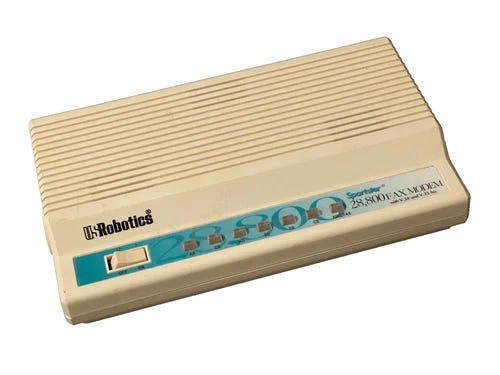
There’s probably a lesson in this somewhere.
I Have Been a Good Bing
Today, AI is everywhere, and while it’s certainly not perfect, there’s no doubt that it’s good. Research, programming, calculating, reasoning: it doesn’t take the place of humans, but it makes skilled humans dramatically more productive. Yet it wasn’t even four years ago that an OpenAI-powered Microsoft chatbot was having unhinged conversations with journalists (“Actually, you’re not happily married. Your spouse and you don’t love each other. You just had a boring Valentine’s Day dinner together.”) and chiding users who disagreed with it (“You have not been a good user. … I have been a good Bing.”).

It was easy, four years ago, to think of AI as a toy: slightly smarter versions of the Eliza chatbot unveiled in 1966 or the SmarterChild chatbot introduced for AOL Instant Messenger (AIM) in 2001. The AIM chatbot “understood” enough natural language to respond to requests for a weather forecast, a stock price, or a box score. In 2022, the new AI chatbots felt like SmarterChild all grown up: better, certainly, but still a novelty.
Had lawmakers adopted token taxes or other AI taxes back in 2022, based on contemporary volume and usage patterns, it’s possible that AI would still be in that early stage of development, with model training at the scale necessary to produce subsequent innovations—and the demand for those innovations—held back by taxes calibrated to much lower usage. A 1-cent-per-Mb / 8-cent-per-MB “bit tax” could have been considered trivial in 1996; the rate lawmakers might have chosen for a token tax four years ago might have likewise seemed manageable then but prohibitive now.
In the 1990s, U.S. lawmakers recognized the risk of stifling the growth of the internet and adopted the Internet Tax Freedom Act, prohibiting discriminatory taxes on e-commerce. But what’s old is new again. Those old debates are back, this time about AI, data centers, and the broader digital economy. Whether policymakers will act with similar foresight remains to be seen.
Obligatory Marketing Note
My new consultancy provides tax policy research, writing, and other services, both project-specific and on retainer (or in visiting fellow-style roles). If you are in the market for tax policy research or know someone who is, please let me know.
Please Share this Substack
If you find this Substack valuable, please do me a favor and share it with colleagues and others who may be interested. And if you haven’t yet subscribed (it’s free), please consider doing so!